Welcome to another edition of Workout Wednesday. Every Wednesday I will post a new Triathlon specific workout. If you like the workout, fit it into your training plan for the week. If you don’t like the workout you’re crazy, all of my workouts are brilliant pieces programming. (kidding)
There are two types of training that affect your speed on the bike. They are muscular endurance and leg strength. Today we are going to work on leg strength. You will soon be bending cranks as you power your way to a new PR.
Leg Crusher
Warm up – Easy Spin
5 X 2 min HEAVY TENSION RPMS 50-60/ 2 min easy pedal
5 min moderate to heavy tension. RPMS 80 -90
4 X 1 min HEAVY TENSION RPMS 50-60
4 X 1 min One Leg Drill. Alt right and left leg.
10 min cool down. Spin easy.
The workout should be performed on a spin bike or trainer. The heavy intervals should really challenge your leg strength, but be sure maintain good form. Fit this workout in your training schedule, where the next day is easy or rest.
Not sure where to begin this story. Yesterday I completed my first (and I vowed) my last triathlon. I was not a happy camper to be coming in near the end. I know that the time shouldn’t have been my priority but I was bummed out. Any way that’s not the beginning.
Thanks to the encouragement of my Brick City Masterswim pals, at the beginning of this year I signed up for Jersey Girl and Iron Girl. And in the spring I began training sans the bike because I didn’t own one. I think I bought my bike in the end of May. I was so fearful of the bike that it took weeks to get on it. It’s a hybrid and lighter than the mountain bike I had borrowed. Riding is not my favorite activity by far.
Welcome to another edition of Workout Wednesday. Every Wednesday I will post a new Triathlon specific workout. If you like the workout, fit it into your training plan for the week. If you don’t like the workout you’re crazy, all of my workouts are brilliant pieces programming. (kidding)
Today’s Workout – Swim Ladder
Some days pool workouts can get so tedious and boring, it feels like torture. You spend your time staring at the black line at the bottom, waiting to touch the wall, and repeat. In today’s workout, the goal is to break it up, and focus key parts of the stroke. Thus, making the workout for interesting and effective.
Swim Ladder
100M – Focus on holding perfect form
200M – Focus on body rotation
300M – Focus on good head position
500M – Work at a nice even pace
300M – Focus on body rotation
200M – Increase your pace
100M – Let it rip. Go as quick as you can with good form
Total: 1700M
If your are not up to swimming these distances yet. You can decrease the distance of each rep. Maybe try do 50, 100, 200, 100, 50. Challenge yourself, and work on keeping the best form possible.
For some tips on proper form, check out these posts:
All of the time, people say you need to break out of your comfort zone. This phrase has become so hackneyed, and cliched that it really holds no meaning. Let’s stop telling people to break out of their comfort zone, and tell them to embrace discomfort. When you push yourself to do something that puts you into discomfort, that is where you are making real change.
I spend the majority of my life in relative comfort. I work in a controlled environment. I drive a car to most places. When I am hungry, I have quick access to food. All of that relative comfort leads to stagnation. My brains says, “why should I push to discomfort, when things are so easy?” It’s a constant fight to resist the urge to stagnate, and push through discomfort to change.
How many of us spend our lives the same way?
Since this is a triathlon blog, let’s relate this to sport. There is times in a race or hard workout where things start to suck. If you are putting in your full effort, there will be a point, where you brain will tell you to slow down. The more times you can resist that voice the stronger you become. You can call it mental toughness, will power, or being a badass.
The key to dealing with the discomfort is to embrace it. Let it happen. When the tough times come, breath, and try to relax. You know this is only temporary, and you will come out stronger on the other side. Think about the greatest accomplishments in your life, and the struggle and discomfort it took to achieve them. Was it worth it? I say hell yes!
Welcome to the first edition of Workout Wednesday. Just as the name implies, I’ll post a triathlon specific workout every Wednesday. These workouts will be geared toward new triathletes. If you are a more advanced athlete you can scale the workout up, with more reps or intensity. I’ll try to keep things interesting with workouts that provide the most benefit for your time.
Let’s get to it:
Cycling Intervals
Bike intervals are the best bang for your buck workouts for gaining cycling fitness. For best results each interval should be performed with intensity. Work hard on the intervals and recover as much as possible on the rests. I recommend doing this workout on a spin bike or trainer with a fan blowing in your face. Also, crank up some music that gets you pumped up.
Here’s the workout:
5 MIN WARM UP
SET 1 – 3 X 1 MIN HARD/ 1 MIN EASY
SET 2 – 3 X 2 MIN HARD/ 1 MIN EASY
SET 3 – 3 X 1 MIN HARD/ 1 MIN EASY
5 – 10 MIN COOL DOWN
Workout time – ~ 31 minutes
Perform each hard interval with intensity. Use the rest to bring down your heart rate, and flush out your legs. If you need an extra minute or two between sets, take it. On the trainer or spin bike set the tension so you are working hard, but keeping your RPMS in the 80-100 range.
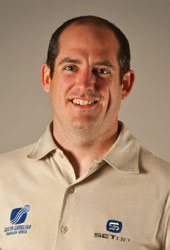
I caught up with Jeremy Davis, owner of Set Up Events, to get the perspective of a race promoter on the first time triathlete experience. Set Up Events is the largest triathlon promoter in the United States, with a series of triathlons in Virginia, North Carolina, South Carolina, Georgia, and Maryland. Jeremy is a triathlete himself, and has been promoting quality events for the past 17 years.
How did you get started with Triathlon?
I was watching the 1996 Atlanta Olympics and saw the triathlon as a provisional sport that year. In the 2000 triathlon was going to be a medaled Olympic sport. I had a running background from soccer, and just cycled across South Carolina. So I figured I could learn to swim and maybe go to the Olympics. Then I got in the pool and realized this may not happen as I can’t swim a length without being out of breath.
In 1997 I started a triathlon club at Clemson University with 30-40 members. I decided to promote my own triathlon on campus for the club. We rented out the pool and had a make shift race for eight of us. I enjoyed promoting the event and wanted to do a larger event at Clemson, so I hooked up with Bill Scott. He was doing events in the Wilmington area. We started working together, and triathlon took off. He needed more help, and I had help to give, so my event promotion career was born.
What was your 1st Triathlon?
It was the Columbus Day Sprint Tri in Myrtle Beach. I was 68th out of the water, had the 2nd fastest run split, and finished somewhere in the middle of the pack. At the end of the race, i thought, this is the hardest thing I have ever done. I need to do it again.
What percentage of your participants are first time triathletes?
We don’t track this particularly, but if I had to guess somewhere around 10% for a sprint race. If it is a pool swim, that number could be higher. I always ask the people in our novice waves, if this is their first race, and 95% of them raise their hands. Olympic distance events are somewhere around 2-5% of first time racers.
Which events in the Setup Brand are good for first timers?
Any of our events with a pool swim are great for first timers. In our South Carolina series, the Tri the Midlands race is great open water swim for new triathletes. A shorter open water swim is great for beginners as they get the feel of a mass start tri, but may not be intimidated by the distance.
What skills of info should first time triathletes focus on?
I would recommend some kind of clinic of coach before they start training for their first race. Find a training plan so you are optimizing your time, and not just swimming, biking and running with no focus. Also, try not to have anxiety about being super fast on your first race. Do your training, and on race day, have fun. Go and do want you have trained your body to do.
Would you recommend a new triathlete volunteer at a race before their first race?
Of course. As a race promoter we always need volunteers. Volunteering at a race gives a new perspective of all the things that go into successful event. During a race you are self focused, constantly doing a body check, and can’t pay attention to mush else. When you volunteer you can see the other moving parts of the race, and recognize the efforts of all of those involved in the race.
Also, first timers might think everyone that does triathlons has six pack abs, and college swimmer shoulders. When in reality triathletes come in all different sizes, and shapes. There may be a 275 LB. man that flies through an eleven minute swim, and struggles through the bike and run. Seeing the range of the abilities at a race can lower the intimidation level for new racers.
What does the future hold for Set Up Events?
Our goal at Set Up Events is to produce quality events that people can afford to race. We want to capture more of the first time market, and people that want to race against their buddies. We pride ourselves on a family feel, and love to see the same people come and race every event.
In Part I, we discussed Body Position and Breathing. Those two skills are very important, but don’t get you anywhere. You need oars to get the boat moving. Your stroke is your oars, and that is what we will cover in this post.
This post in not meant to be the definitive post on stroke technique. The goal here is to master the fundamentals and set a good base for refinement as your swimming progresses. A perfect freestyle stroke, if there is really such a thing, takes years to develop. With a good fundamental stroke you will be able to cover longer distances with better efficiency.
The freestyle stroke can be broken down into four parts:
Coach Gerry Rodriguez of Tower26 in Southern California without a doubt is one of the foremost experts in the world of open water swimming. Hailing from the island of Trinidad, Gerry began swimming at age seven. He has won numerous Masters national titles, a few world Masters titles while achieving national and world Masters records, a 28.5-mile swim around Manhattan Island. He now focuses on coaching some of the world’s best triathletes and open water swimmers. Below is a piece written by Coach Gerry Rodriguez that we have been given permission to share with our Fit Endurance readers.
DON’T ……
1. Breathe every 3rd stroke or higher.
2. Hold your breath before expulsion.
3. Breathe through your nose.
4. Take short, shallow breaths.
5. Linger while taking a breath.
6. Focus on front quadrant or catch-up style swimming.
7. Over rotate with hips. 8…







 First Time Triathlete